



Against the backdrop of an increasingly competitive global investment landscape, where comparative advantages are shifting from low costs to institutional excellence, advanced technologies, and innovation, next-generation Foreign Direct Investment (FDI) has become an irreversible trend. This requires localities to transition from a project-attraction approach to a strategic investor-selection model, prioritizing high-quality investments that foster long-term, sustainable development.
Recognizing this global shift, Phu Tho has adopted the Strategic Framework for attracting next-generation FDI, 2026–2030. The Framework outlines a fundamental transition from pursuing investment quantity to attracting high-quality, technology-intensive, efficient, and sustainable investment projects. Its overarching objective is to position Phu Tho as a regional hub for industry, services, and logistics in Vietnam’s Northern midlands and mountainous Region.
From conventional strengths to new competitive advantages
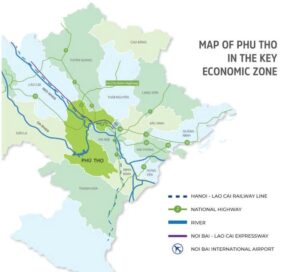
Following the administrative consolidation, Phu Tho now encompasses a development area of over 9,360 km² and a population of more than four million, positioning the province as one of the largest economic and consumer markets in Vietnam’s Northern midlands and mountainous Region. Strategically located at the western gateway to Hanoi, with excellent connectivity to major economic hubs—including Hanoi, Bac Ninh, Hai Phong, and Thai Nguyen—and situated along the Kunming–Lao Cai–Hanoi–Hai Phong economic corridor, Phu Tho is well positioned to integrate more deeply into regional manufacturing networks and global value chains. These locational and connectivity advantages constitute a cornerstone of the province’s Strategic Framework for attracting next-generation FDI.
As of 15 March 2026, Phu Tho Province hosted 747 active FDI projects, with a combined registered investment capital of approximately USD 15 billion, originating from 28 countries and territories. FDI inflows have been concentrated primarily in electronics, automobiles, motorcycles, mechanical engineering, manufacturing and processing, and supporting industries. Nevertheless, the current investment portfolio remains dominated by processing and assembly activities, characterised by relatively low domestic value addition and limited technology and knowledge spillovers. The level of localisation and research and development (R&D) activities remains modest, while competition among subnational jurisdictions to attract technology-intensive investment has intensified significantly.
These trends underscore that maintaining a conventional investment attraction model will constrain Phu Tho’s ability to capture the emerging wave of next-generation FDI associated with the ongoing restructuring of global value chains.
Attracting next-generation FDI: beyond capital mobilization
The defining feature of the Framework is a fundamental shift in the province’s development paradigm. Whereas previous efforts focused primarily on increasing the number of investment projects and the volume of registered capital, the new approach places greater emphasis on the quality of investment. Priority will be accorded to projects that are technology-intensive, environmentally sustainable, resource-efficient, capable of generating high value added, and well-positioned to establish strong production linkages with domestic enterprises.
Investment promotion efforts will target strategic industries, including electronics, semiconductors, electric vehicles, precision engineering and advanced manufacturing, supporting industries, data centres, smart logistics, high-tech agriculture, biotechnology, green energy, financial and banking services, digital technologies, high-quality education and healthcare, and premium tourism and hospitality… Concurrently, the province will prioritise engagement with investors from Japan, the Republic of Korea, the United States, the European Union, Singapore, China, and Taiwan (China)…, together with other strategic partners possessing advanced technological capabilities, modern management practices, and a demonstrated commitment to sustainable and responsible investment.
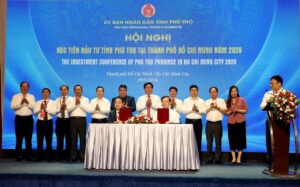
The overarching principle of the Framework is that FDI attraction must be fully aligned with the Party’s guidelines and the Government’s policies on attracting foreign investment in the new context, as set out in Resolution No. 50-NQ/TW, Resolution No. 57-NQ/TW, and Resolution No. 68-NQ/TW. During the 2026–2030 period, Phu Tho will pursue a selective and quality-oriented FDI attraction strategy, giving priority to projects that deliver advanced technologies, innovation, high economic efficiency, and sustainable development. Investment attraction will be closely integrated with the transformation of the province’s growth model, the promotion of the green and digital economy, and the enhancement of local competitiveness. Rather than focusing on the number of projects or the volume of registered capital, the province will prioritize quality, economic efficiency, technological sophistication, value creation, and environmental sustainability. At the same time, greater emphasis will be placed on strengthening linkages between foreign-invested enterprises and domestic firms to foster an integrated and modern industrial ecosystem while enhancing the role of the private sector.
Phu Tho is committed to building a service-oriented and investor-centric government that works alongside businesses. Investor satisfaction will serve as a key performance indicator of public administration, contributing to a transparent, secure, and efficient investment environment.
Building an integrated next-generation investment ecosystem
A defining feature of the Strategy is its shift from a traditional project-based promotion approach to the development of a comprehensive next-generation FDI ecosystem.
To this end, the province will formulate and adopt a Set of Criteria for choosing next -generation FDI Projects, which will serve as the unified basis for the entire investment management process, including investment policy approval, investor selection for industrial parks, the determination of investment incentives and support measures, and project monitoring and evaluation. Special Task Forces, chaired directly by the Chairman of the Provincial People’s Committee, will be established to coordinate implementation and resolve complications. In parallel, the province will introduce a single-window investor service mechanism to streamline administrative procedures and significantly reduce processing times. Phu Tho will also escalate regular dialogues and reinforce post-investment monitoring to ensure that next-generation FDI projects achieve high standards of quality and efficiency.
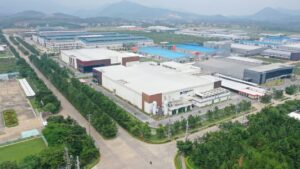
At the same time, Phu Tho will promote the development of specialized industrial parks for next-generation FDI and smart industrial parks, equipped with high-quality physical infrastructure, advanced digital infrastructure, modern logistics systems, and business support services. These developments will provide a solid foundation for attracting high-tech investment and fostering cutting-edge and sustainable supply chains.
Investment promotion will also undergo a fundamental transformation. Rather than adopting a broad-based approach, the province will proactively engage with leading multinational corporations, high-technology enterprises, and Tier 1 and Tier 2 suppliers, thereby improving the quality and strategic value of FDI inflows. In parallel, Phu Tho will leverage the catalytic role of reputable industrial park developers to enhance infrastructure readiness and strengthen the province’s positioning on the map for next-generation FDI.
Businesses at the centre of public services
A key feature of the Framework is the establishment of a comprehensive investor support mechanism that accompanies businesses throughout the entire project lifecycle.
Accordingly, the province will introduce a “one-stop – one focal point – one dedicated task force” model for each investment project. Phu Tho will also establish a Provincial Investment Promotion Steering Committee (covering both FDI and domestic direct investment (DDI)), chaired directly by the provincial leadership, to strengthen interdisciplinary coordination and ensure the timely resolution of rising issues. In addition, the province will standardize and digitalize the entire investment administration process, publicly disclose processing timelines, develop an online project tracking system, establish a 24/7 investor feedback mechanism, and institutionalize regular government–business dialogue.
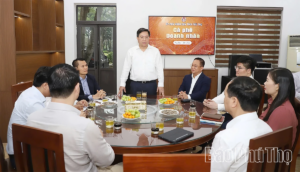
This approach is expected not only to shorten project implementation timelines but also to strengthen investor’s confidence by enhancing the transparency and predictability of the investment environment.
Fostering the development of domestic enterprises alongside FDI
Sustainable economic development can only be achieved when foreign-invested enterprises and domestic firms grow and prosper together. Accordingly, this Framework places strong emphasis on establishing an FDI–DDI linkage whose key measures include promoting the development of supporting industries, establishing a comprehensive database of local enterprises, enhancing the transparency of supply and demand information for components, and providing targeted support to improve firms’ managerial capabilities, product quality standards, and compliance with ESG standards. These measures are intended to enable domestic enterprises to integrate more deeply into regional and global value chains.
This represents a significant shift from a traditional investment attraction approach towards the development of a modern industrial ecosystem, in which domestic enterprises are not merely passive beneficiaries but strategic partners of multinational enterprises.
Human force: A critical determinant of success
Apart from infrastructure and institutional quality, the availability of a highly skilled workforce is recognised as a critical determinant of competitiveness in attracting next-generation FDI.
This Framework sets a target of training approximately 50,000 skilled technical workers by 2030 through an employer-led, demand-driven training mechanism. Priority measures include strengthening partnerships between vocational education and training institutions and enterprises; standardising training curricula; develop laboratories, practical training workshops, and production-integrated training models. At the same time, the province will explore the establishment of a regional technical training centre to meet the growing demand for skilled human resources in high-technology industries over the coming years.
In parallel, Phu Tho province promotes innovation by developing the provincial innovation fund and strengthening collaboration between enterprises, universities and research institutes. These efforts are intended to foster a dynamic research and innovation ecosystem and to accelerate technology transfer.
Affirming a new development vision
Phu Tho’s strategy for attracting next-generation FDI is not only a means of increasing inflows of foreign capital; it represents a fundamental shift in the province’s development mindset. Rather than competing primarily on traditional cost-based advantages, Phu Tho is positioning itself to compete through high-quality governance, innovation capacity, a skilled workforce, and a transparent investment environment.
Against the backdrop of the ongoing global restructuring of supply chains, the comprehensive implementation of the Framework will provide a solid foundation for attracting high-tech investment projects, enhancing the value-added contribution of the provincial economy, promoting the development of supporting industries, and strengthening linkages between domestic and FDI enterprises. In doing so, the province aims to foster a modern, and sustainable investment ecosystem.
This vision extends beyond the objectives of the 2026–2030 period. It represents a strategic step towards establishing Phu Tho as a leading industrial, services, logistics, and innovation hub in the Northern midlands and mountainous Region in the coming years.
Nguyễn Thị Thơm - Translated by Đặng Thị Lâm Tuyền