



In the course of national development, urbanisation is not only an inevitable trend but also a key driver of economic growth, improved quality of life and the creation of new development space. In line with national agenda and Phu Tho’s provincial master Plan, the Provincial People’s Committee issued Decision No. 2531/QD-UBND dated 4 August 2026 approving the provincial urban development Initiative for the 2026–2030 period. The Initiative sets out clear objectives, implementation pathways and solutions to developing the provincial urban towards a greener, smarter, more modern and sustainable system.
Building a modern and integrated urban system
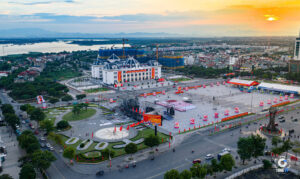
Following the reorganisation of administrative units, Phu Tho has a large development space, a population of more than 4 million people, a diverse urban system and significant potential for inter-regional connectivity. The urban development Initiative for the 2026–2030 period has been formulated to capitalise on the province’s geographical advantages, strengthen connectivity with Hanoi, the Red River Delta and the Northern Midlands and Mountainous Region, and progressively position Phu Tho as an industrial, service and logistics hub of the Northern Midlands and Mountainous Region.
The Initiative’s overarching objective is to develop the provincial urban system in a focused and selective manner, avoiding dispersion. Priority will be given to urban areas serving as administrative and economic centres, growth poles, gateways, industrial and service centres, tourism destinations and ecological urban areas. Urban development will be closely integrated with economic corridors, strategic transport axes, industrial parks, industrial clusters, logistics centres, commercial and service hubs, facilities for tourism, healthcare, education and culture, as well as other key development areas of the province following the administrative consolidation.
The organisation of the urban system will follow a polycentric and interconnected model that is consistent with the province’s new spatial structure following the merger. Phu Tho’s urban development structure is based on the framework of “four development zones – three economic corridors – one ecological belt – five strategic development axes.” This framework provides the basis for guiding the distribution of key urban areas, transitional urban areas, industrial parks, logistics facilities, tourism areas and emerging development areas; for establishing growth poles, priority urban development and interconnected urban clusters along economic and infrastructure corridors. It will thereby support economic growth, economic restructuring, improvements in living standards and enhanced provincial competitiveness.
The province will promote green, smart and climate-resilient urban development; improve the efficiency in using land, natural resource and energy; protect the environment; conserve cultural and historical heritage, landscapes and local identity; and expand the application of digital transformation, urban data platforms, Geographic Information Systems (GIS), artificial intelligence and other emerging technologies in urban management, operation and development.
By 2030, the province aims to achieve an urbanisation rate of approximately 40%, providing an important foundation for strengthening competitiveness, attracting investment and improving people’s quality of life.
Focusing on the development of 14 key urban areas
A key component of the Initiative is the focused development of 14 strategic urban areas, in line with Phu Tho’s provincial master Plan for the 2021–2030 period, with a vision to 2050. These urban areas will serve as the core for socio-economic development and generate spillover and growth momentum across the province.
Five urban areas are planned to achieve class II status, namely Viet Tri, Phu Tho, Hoa Binh, Vinh Yen and Phuc Yen. These urban areas constitute major administrative, economic, industrial, commercial and service centres of the province and will receive priority investment in integrated technical infrastructure, social infrastructure, urban architecture and landscape, and urban governance capacity.
+ Viet Tri Urban Area (comprises the administrative boundaries of Viet Tri, Nong Trang, Thanh Mieu and Van Phu Wards; and Hy Cuong, Song Lo, Tien Lu and Son Dong Communes).
+ Phu Tho Urban Area (comprises the administrative boundaries of Phu Tho, Au Co and Phong Chau Wards).
+ Hoa Binh Urban Area comprises the administrative boundaries of Hoa Binh, Thong Nhat, Ky Son and Tan Hoa Wards and Thinh Minh Commune.
+ Vinh Yen Urban Area comprises the administrative boundaries of Vinh Yen and Vinh Phuc Wards, and Te Lo, Hoi Thinh, Binh Xuyen, Yen Lac and Xuan Lang Communes.
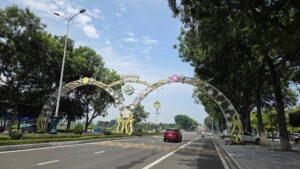
+ Phuc Yen Urban Area comprises the administrative boundaries of Phuc Yen and Xuan Hoa Wards, and Binh Nguyen and Binh Tuyen Communes.
In addition, the province will develop nine urban areas planned to achieve class III urban status, namely Lam Thao, Luong Son, Vinh Tuong, Tam Hong, Thanh Thuy, Tam Dao, Tam Duong, Cam Khe and Lap Thach. Investment in these urban areas will focus on backbone and essential infrastructure, with the progressive completion of missing criteria to improve the quality urban growth.
The geographical scope of the aforementioned 14 urban areas encompasses 35 of the 60 existing urban areas that have been designated for transitional arrangements by Phu Tho’s Provincial People’s Committee under Decision No. 678/QD-UBND dated 13 March 2026 on the publication of the list of class II and class III urban areas and wards meeting the prescribed urban development standards applicable to administrative units within class II and class III urban areas.
The remaining 25 of the 60 existing urban areas incorporated into the transitional urban system under Decision No. 678/QD-UBND dated 13 March 2026, will continue to be maintained, managed and invested in further development in accordance with appropriate agenda, ensuring continuity and stability in urban development management post-merging.
Key targets
The Initiative establishes a set of specific targets aimed at improving the quality of urban life:
– Complete the urban classification criteria for the 14 priority urban areas, with particular attention to inadequate or underperforming criteria relating to population size, population density, technical infrastructure, social infrastructure, environmental quality, urban landscape and urban development management capacity.
– Ensure that 100% of urban areas covered by the Initiative undergo the review and updating of urban plans and construction plans, or the preparation or adjustment of such plans, together with architectural management regulations and relevant action plans.
– Improve the quality of urban infrastructure, prioritise investment in urban transport, water supply, drainage, wastewater treatment, solid waste collection and treatment, green spaces and public lighting, digital infrastructure and public facilities, in accordance with approved plans, applicable technical standards, and available resources.
– For indicators relating to land allocated to transport infrastructure, green space, clean water supply, solid waste collection and treatment, wastewater treatment, and industrial park and industrial cluster infrastructure, implementation will follow each pathway with applicable scope and investment priorities.
– Ensure adequate land and floor space for education, healthcare, cultural and sports facilities, in accordance with spatial plans, applicable technical standards, and on-site conditions.
Heading for green, climate-resilient and sustainable urban development
A defining feature of Phu Tho’s provincial urban development Initiative for the 2026–2030 period is its emphasis on green, environmentally sustainable and climate-resilient urban development.
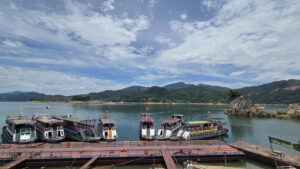
Accordingly, Phu Tho will pursue an urban development approach based on the principle that economic growth should not come at the expense of environmental sustainability. The province will integrate greenhouse gas emissions reduction, circular economy approaches, efficient resource use, biodiversity conservation and the protection of green spaces, water bodies, floodways, rivers and streams, regulating lakes and natural landscapes.
For class II urban areas, priority will be given to the integrated development of green and environmental infrastructure, sustainable transport, energy-efficient public lighting, green buildings, digital transformation, drainage and flood management, wastewater treatment, solid waste management and enhanced climate resilience.
For class III urban areas, priority will be given to essential technical infrastructure, green and public spaces, drainage, wastewater and solid waste treatment, urban regeneration and upgrading, transport connectivity and the effective management of urban spatial expansion.
Particular attention will be paid to riverfront and lakeside and mountainous areas as well as locations vulnerable to flooding, landslides, flash floods and debris flows. In these areas, spatial development will be subject to strict controls, while floodways, river and stream corridors, water bodies, forests, natural landscapes and other ecological assets will be protected. Measures for disaster risk reduction and climate change adaptation will also be implemented.
Mobilising resources
To guarantee its feasibility, the Initiative sets out a comprehensive package of institutional, policy and resource mobilisation measures.
The province will prioritise public investment resources for backbone infrastructure, essential infrastructure, inter-regional projects and inadequate urban development criteria. At the same time, land-based financing mechanisms will be utilised more effectively through land-use rights auctions, the development of new urban areas, and urban regeneration and redevelopment.
The province will also diversify financing sources, including central government and local government budgets, Official Development Assistance (ODA), Public–Private Partnerships (PPPs), Foreign Direct Investment (FDI), green finance, green credit, private-sector investment, non-state and other lawful sources of funding, where resources from sectoral programmes, schemes and action plans will be integrated to support the Initiative.
The province will further promote administrative reform, improve the quality of spatial and urban planning, strengthen urban governance capacity and establish an integrated urban data system to support management and administration.
A new force for a fast and sustainable Phu Tho
Not only is Phu Tho’s provincial urban development Initiative for the 2026–2030 period a framework for urban spatial development but also an action-oriented agenda designed to establish the foundations for socio-economic growth in a new phase of development. Through the strategic development of 14 key urban areas, improvements in the quality of urbanisation, and the promotion of green, smart and sustainable urban development, Phu Tho is progressively advancing towards its objective of becoming a dynamic province and an important industrial, services and logistics hub of the Northern Midlands and Mountainous Region.
The strong commitment of the entire political system, accompanied by the engagement and support of local and the business communities, will be critical to achieving the objectives of the 2026–2030 urban development Initiative. These efforts will contribute to building a Phu Tho that is increasingly civilised, modern, liveable and sustainable.
Translated by Đặng Thị Lâm Tuyền By Nguyễn Thị Thơm